

LOCKED OUT
A Report on Springfield, Missouri’s Eviction Crisis
Table of Contents
(click on a link to jump to that section)
Executive Summary
This report's central recommendation is that Springfield adopt a Right to Counsel (RTC) policy, guaranteeing legal representation for low-income tenants facing eviction. RTC is a public policy tool adopted in jurisdictions across the country—including Kansas City, Cleveland, and Nashville, which this report examines in detail. RTC reduces avoidable evictions, prevents homelessness, helps tenants access resources that can assist with rent, and increases fairly negotiated agreements, including payment arrangements, between landlords and tenants.
The evidence from other jurisdictions is strong. Kansas City's RTC program cut default judgments from 45.9% to 37.5% and eviction judgments from 60.7% to 50.9% in its first three years¹. Cleveland's program returned $2.46 for every $1 invested and helped 85% of clients avoid disruptive displacement². Nashville's program achieved clients’ goals in 93% of cases (keeping 370 households stably housed) and generated a total financial return of $4.18 for every dollar invested in 2025, of which $2.32 was fiscal impact directly realized by Davidson County³.
Eviction is a leading cause of homelessness. Once a household is evicted, the chances of losing their job, custody of their children, and financial stability increase sharply, along with the cost to our community. Many of these evictions are avoidable: with the right support at the right moment, renters facing a temporary crisis can access rental assistance or negotiate a payment plan before a judgment derails their housing. The most recent Springfield-specific estimate, from 2022, places the annual public cost of one unsheltered adult at approximately $30,597 in policing, cleanup, municipal court fees, and medical expenses⁴. This is consistent with national estimates: the U.S. Interagency Council on Homelessness has put the cost of chronic homelessness at $30,000 to $50,000 per person per year, with health care and criminal justice interactions driving most of the expense⁵.
The imbalance in eviction court is severe. From May 19 to September 1, 2026, trained community volunteers observed 142 eviction court cases in person in Springfield⁶. In 141 of those cases, the tenant had no attorney. Landlords had legal representation in 123. Most hearings lasted less than 10 minutes, and tenants regularly appeared confused by the process: asking for more time or attempting to speak directly with their landlord, only to lose on procedural errors.
Springfield has 42,595 renter households, approximately 55% of all occupied households in the city⁷. In 2025, there were 2,292 eviction filings in the city, according to data prepared for STUN by the Eviction Lab⁸. The city's serial filing rate is 14.02% over a two-year period: 4,431 filings were made against 3,694 unique households, with 518 households receiving more than one filing.
A CaseNet analysis of 2,906 eviction cases from June 2025–2026 shows that 32.9% ended in default judgment (957 cases), meaning the tenant did not appear or respond⁹. Kansas City's RTC program reduced default judgments from 45.9% to 37.5% in its first three years. Excluding Springfield's default cases, where a tenant does not appear and therefore cannot be represented, the program's target population is the remaining cases where tenants do appear or reach out to legal aid. Using Stout's RTC cost estimation tool and the assumptions detailed in Section V, it is estimated that an RTC program would ultimately represent approximately 1,260 tenants per year at full implementation, at an annual cost of approximately $3.04 million.
Springfield Tenants Unite (STUN) recommends a phased five-year implementation. In Year 1, the program would represent approximately 252 tenants at a cost of approximately $800,000, ramping up to full implementation by Year 5. This phase-in approach allows for building provider capacity, making programmatic adjustments, and scaling deliberately toward full funding. Kansas City’s experience demonstrates why this matters: even with expanded capacity, legal service providers there remain insufficiently staffed to meet demand, with one provider turning down nearly 30% of tenant requests since 2023¹⁰.
Introduction
In February 2025, the Springfield City Council referred a Right to Counsel ordinance to its Community Involvement Committee (CIC). The ordinance would guarantee legal representation for low-income tenants facing eviction. It has appeared on the committee’s agenda twice since then for no more than 15 minutes each time.
This report is STUN’s effort to provide the evidence that ordinance deserves. It documents what eviction court looks like in Springfield, reviews what has happened in other cities that have adopted Right to Counsel, and makes the case, fiscal and moral, for Springfield to do the same.
How this report was produced
The report draws on four sources of evidence:
Court watch: From May 19 to September 1, 2026, STUN trained community volunteers to observe eviction court proceedings in person at the Greene County circuit court, where Springfield eviction cases are heard. Volunteers attended hearings based on availability rather than random sampling, and recorded the presence or absence of legal representation for both parties, the approximate duration of each hearing, and qualitative notes on the proceedings. The findings describe what occurred in the 142 cases that were observed and should not be read as a statistical estimate of all eviction cases filed in Springfield during that period. Methodology notes appear in Section II.
CaseNet analysis: STUN compiled disposition data for 2,906 eviction cases filed in Springfield from June 2025 through June 2026 using Missouri CaseNet, the state’s public online court records system. Each case was coded by disposition type. Note: CaseNet data may contain coding errors. Methodology notes appear in Section III.
Eviction Lab analysis: The report draws on a five-year analysis of Springfield eviction filings¹¹ prepared for STUN by the Eviction Lab at Princeton University. The analysis covers filing trends from 2020 through 2025, with partial 2026 data, district-level patterns, and serial filing data and a list of the most frequent eviction filers. The dataset is not part of the lab’s public national database but was prepared by their research team using the same methodology. Methodology notes appear in Section I.
Published evaluations: The report reviews Right to Counsel programs in Kansas City, Cleveland, Louisville, Nashville, and Toledo. Kansas City shares Springfield's state legal framework. Cleveland and Nashville are mid-sized cities with comparable political and legal climates and independent evaluations from Stout (a national advisory firm that has conducted cost-benefit analyses of eviction right to counsel programs in over 40 jurisdictions). Louisville reports program outcome and caseload data. Toledo's pilot produced strong first-year results, but its funding was not sustained. Like Springfield, all five cities saw eviction filings rise after pandemic-era protections ended; the evaluations show what happened when those cities chose to invest in evidence-based housing solutions.
What this report covers
Section I describes Springfield’s eviction landscape: filing trends, district-level patterns, and the landlords who file most frequently.
Section II presents the court watch findings: what volunteers observed, what tenants experienced, and what the data shows about representation and hearing length.
Section III analyzes CaseNet disposition data, including the share of cases ending in default judgment and the amounts owed at filing versus after judgment.
Section IV defines Right to Counsel, distinguishes it from what it is not, and reviews the evidence from Kansas City, Cleveland, and Nashville.
Section V examines the cost of doing nothing—the eviction-to-homelessness pipeline and the fiscal case for prevention.
Section VI presents STUN’s recommendations, including a phased five-year implementation plan.
A glossary of terms appears after this introduction, and a full list of sources appears at the end of the report.
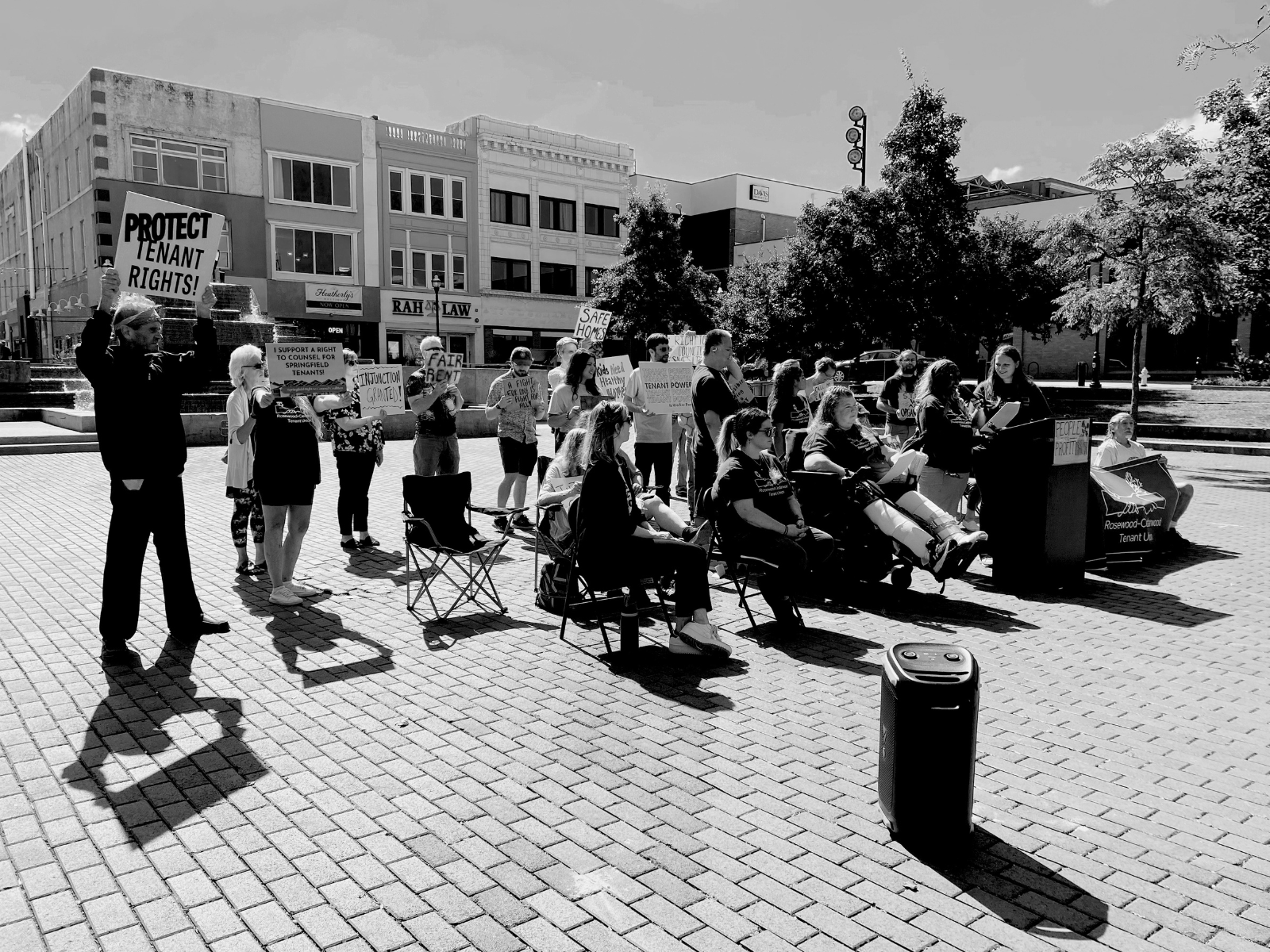
Springfield has 42,595 renter households, approximately 55% of all occupied households in the city.
Glossary of Terms
Eviction Process
Eviction — The legal process a landlord must use to remove a tenant from a rental property. In Missouri, these cases are filed in associate circuit court as landlord-tenant actions.
Eviction filing — The court filing that starts an eviction case. A filing is not the same as an eviction: many cases end in dismissal, settlement, or a consent judgment. But an eviction filing typically affects a tenant’s future housing prospects regardless of the outcome of the eviction case. Filing counts are the standard measure of eviction pressure in a community.
Eviction filing rate — the number of eviction filings in a year divided by the number of renter households. Springfield’s rate is 5.38%, meaning roughly 5 filings for every 100 renter households annually.
Serial filing — A filing against a household that has already been filed against at least once during the measurement period. Springfield’s serial filing rate is 14.02% over a two-year period: about one in seven filings is against a household that has been through the process before.
Judgment — The court's final decision in a case. In eviction cases, it typically determines both possession of the property and any money owed.
Rent and Possession — An eviction case filed when a landlord alleges the tenant hasn't paid rent. Under RSMo § 535.160, a tenant can stop the case by paying all rent owed plus court costs and attorney fees on the date the judge decides the money judgment. But the right is procedural, not automatic: the tenant must appear in court at the right time and follow the required steps. Missing that moment or failing to fully adhere to the required procedures means losing the right to cure—one of the procedural traps that unrepresented tenants most often fall into.
Unlawful Detainer — An eviction case filed when a tenant allegedly remained in the property after the tenancy has ended, such as after a lease expires or is terminated for a lease violation. Unlike rent and possession, the issue is the right to possession, not unpaid rent (although a landlord can seek unpaid rent in this context), and there is no statutory cure right.
How Cases End
Disposition — The final resolution of a case. This report uses the following categories:
Default Judgment — A judgment for the landlord because the tenant did not appear or respond within the required time. A default does not mean the tenant had no defense—it means the tenant was not present or did not raise one.
Consent Judgment — A judgment entered by agreement of both parties, usually before the hearing. Often includes a payment plan or an agreed move-out date.
Dismissed by parties — The landlord withdrew the case, often because the tenant paid or the parties reached an agreement outside court.
Dismissed without prejudice — The judge dismissed the case in a way that does not bar the landlord from refiling the same claim.
Dismissed with prejudice — The judge dismissed the case in a way that bars the landlord from filing the same claim.
Trial by court — The judge decided the case after hearing evidence from both sides. (Note: Most Missouri eviction cases proceed as a trial by court, though parties do retain the legal right to request a jury trial.)
Not disposed — Still pending (when the dataset was compiled).
Legal Representation
Tenant Right to Counsel (RTC) — A policy guaranteeing legal representation for eligible tenants facing eviction.
Pro se — Representing oneself in court without an attorney. In Springfield, a four month court watch program observing 142 cases found that 99.3% of tenants appeared pro se.
Housing & Homelessness
Disruptive displacement — A move that occurs under duress–-through eviction, foreclosure, or other involuntary loss of housing— and carried out by a marshal or sheriff. RTC evaluations track the share of clients who avoid disruptive displacement.
Avoidable eviction — An eviction that would not proceed if the tenant had legal representation to raise a valid defense, negotiate a payment plan, secure necessary resources, or correct a procedural error.
Point-in-Time count — An annual one-night count of people experiencing sheltered and unsheltered homelessness, conducted by the Continuum of Care agencies. Springfield’s January 2025 count identified approximately 588 people. PIT counts are widely understood to undercount the true homeless population due to the difficulty of locating all individuals in a single night and limits on agency and volunteer capacity. They remain a useful indicator of scale and trend.
Data Sources
Eviction Lab — A research initiative at Princeton University that compiles and publishes eviction filing data for jurisdictions across the US, including Springfield, MO.
CaseNet — Missouri’s online public court records system, maintained by the Office of State Courts Administrator. STUN used CaseNet to compile the case-level dataset in this report.
Stout — A national advisory firm that has produced cost-benefit evaluations of RTC programs across the US. Stout also developed the RTC cost estimation tool used in this report.
Springfield Court Watch Pilot — A program in which trained community volunteers observed 142 eviction court cases in person in Springfield between May 21 and September 1, 2026. Court watch documents how the legal process actually functions for unrepresented litigants. The pilot's observations were supplemented with CaseNet data covering the same period, providing totals on eviction filings, case types, amounts allegedly owed at filing, and case dispositions.
Organizations
Springfield Tenants Unite — Springfield’s citywide tenant union representing renters.
Springfield Apartment and Housing Association (SAHA) — A trade association representing landlords, property managers and developers.